
Knauf Attic Insulation in Spring Valley: A Homeowner’s Guide
Knauf attic insulation in Spring Valley is a strong choice for a hot-desert attic, and the reason is simple: Knauf makes two products that suit two very different jobs, and both are well-specified for our climate. EcoBatt batts fit clean, regular framing where you can cut and place a known thickness. Jet Stream blown fiberglass covers the messy, irregular cavities that batts can’t reach. The catch most homeowners never hear: which one you get matters far less than how carefully it’s installed. A rushed install with either product delivers a fraction of what the spec sheet promises. If you’d rather not climb into a 130-degree attic to sort this out yourself, call (833) 588-6196 and we’ll take a look.
What Knauf products actually show up in a Spring Valley attic?
Knauf’s attic lineup boils down to two families, and they don’t do the same work.
- Knauf EcoBatt batts are pre-cut fiberglass with a kraft or binder face, made for standard joist bays and stud cavities. In an attic they’re a good fit over a flat, regularly spaced ceiling where the bays are clean and uncluttered. The binder holds the shape, so they cut and stay put.
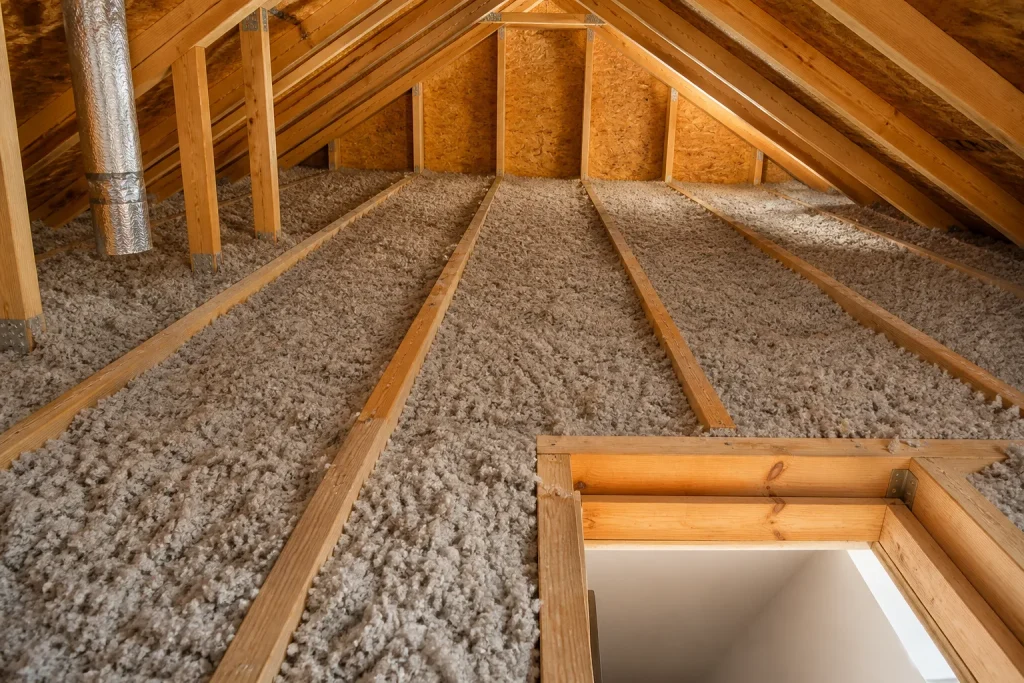
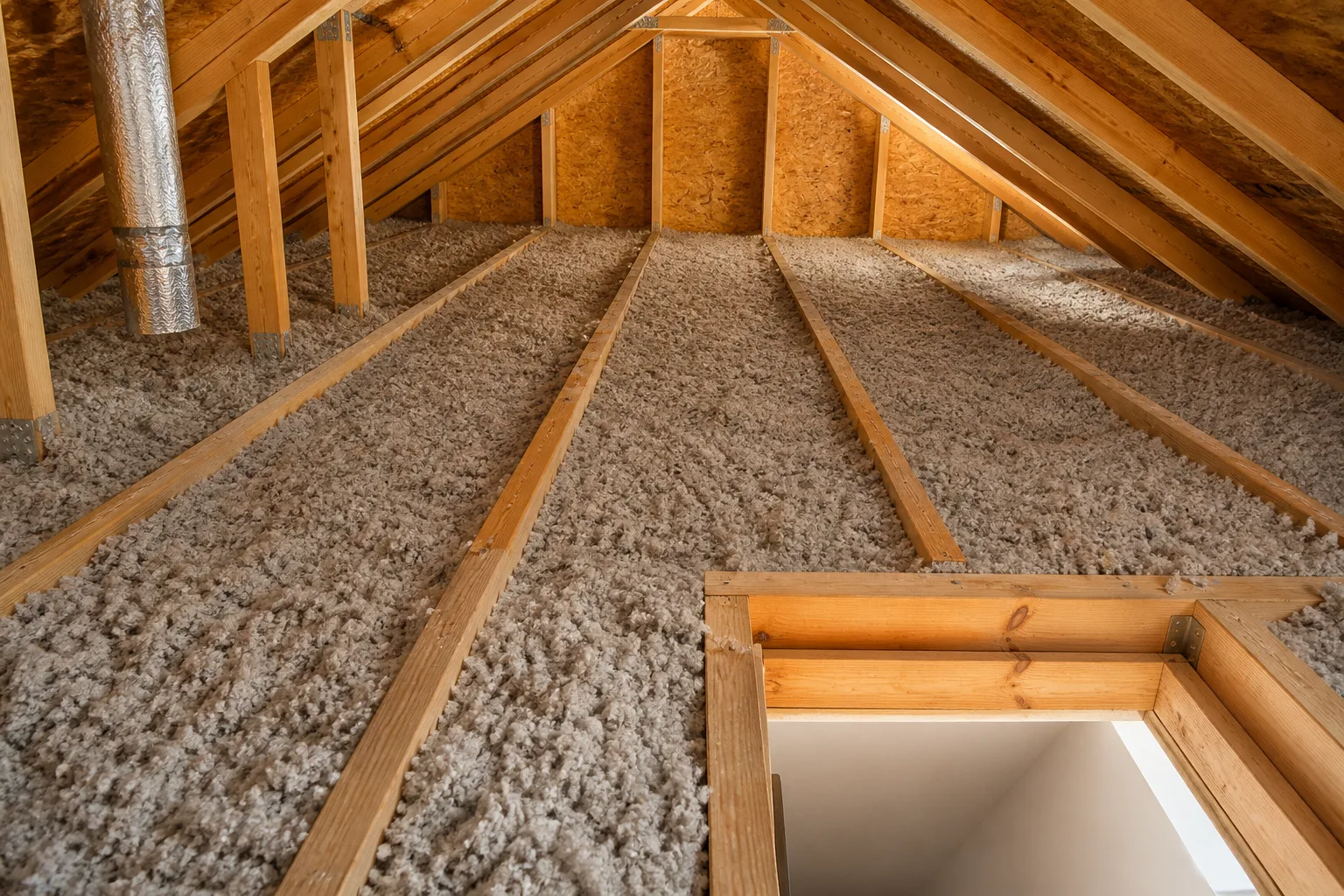
- Knauf Jet Stream Ultra is the blown fiberglass product. It’s installed with a blowing machine to fill the irregular, open areas: around ducts, over top plates, into corners, and across the entire field where batts won’t sit flat. Blown fiberglass lets an installer build depth evenly and reach the whole attic floor.
Here’s the part that matters for a house in Spring Valley. Attics here get brutally hot for months, and heat drives the decision. Batts work when the framing is uniform and nothing’s in the way. When ducts, wiring and oddly shaped framing interrupt the field, blown fiberglass wins because it settles into the gaps. In our experience, most attics in this area need the blown product to get consistent coverage, with batts reserved for specific bays or wall-adjacent areas. We carry both because the right answer depends on the attic, not on what’s easiest to hand through the access hatch.
Why does the R-value on the bag not match what you feel in the house?
The bag gives you a tested R-value per inch. What it can’t give you is coverage uniformity, and that’s what separates a good install from a bad one.
Knauf’s blown fiberglass carries a rated R-value per inch measured under controlled conditions. Those numbers are real, but they assume the product is installed at the correct density and blown level across the whole attic with no thin spots. A rushed install that hits significant voids can cut effective performance by a third, even with the same bag count on the invoice. Same product, same paperwork, measurably worse result. Everything rides on installation density.
There’s a second factor people forget: settling. Blown fiberglass is lightweight and airy, and over the first year it settles a bit as it packs under its own weight and the attic’s heat cycling. A good installer anticipates this and blows past the target depth so the settled depth still meets spec a year later. An installer chasing a quick turnaround blows to the label and moves on. You get the performance you paid for only if the depth gets checked after settling, not just at the drop.
If your attic reads warm in summer and cold in winter despite insulation being “there,” the product isn’t the likely problem. Coverage is. To get that looked at properly, our Attic Insulation Spring Valley page walks through what a full assessment covers.
Knauf vs. other materials: how does it compare for a Spring Valley retrofit?
Knauf blown fiberglass is one option among several, and comparing it honestly helps you ask better questions.
Knauf blown fiberglass vs. cellulose. Fiberglass doesn’t settle as much as cellulose over time, and it resists moisture better in a dry climate. Cellulose, like the GreenFiber blown-in option we install, packs denser and can be a good choice for homeowners who want recycled material. Neither is “better” in the abstract; they behave differently.
Knauf vs. mineral wool. Rockwool mineral wool brings fire resistance and moisture resistance that fiberglass doesn’t match, and it’s excellent for sound. In an attic, though, its higher cost is often hard to justify unless fire performance is the priority.
Knauf vs. spray foam. This is the biggest fork in the road. Icynene open-cell spray foam and Demilec closed-cell systems do two jobs at once: they insulate and air-seal, because the foam expands to fill every crack and gap. Blown fiberglass insulates but doesn’t stop air movement, so it needs separate air-sealing first. In a Spring Valley attic where hot air and air leaks are a real problem, spray foam often earns its higher cost. For a straightforward top-up where the attic is already reasonably sealed, Knauf blown fiberglass does the job well for less. If you’re weighing the two, our spray foam insulation page explains where the closed-cell and open-cell systems fit.
One more retrofit note: Knauf blown fiberglass pairs cleanly with a radiant barrier because it’s inorganic and won’t hold moisture against the foil. A retrofit that combines a barrier on the roof deck with a proper Knauf blown floor is a common approach in this climate.
What should you check to make sure a Knauf install is done right?
You can’t watch every minute, but you can check the finished work. These are the markers a careful installer leaves behind.
- Visible depth markers. A proper install leaves rulers, marked stakes or depth gauges standing in the blown insulation so anyone can confirm the depth later. If they’re gone, ask why.
- A coverage chart. The installer should be able to show the bag-count-to-depth chart for the product and explain how the target depth was set for your attic.
- Even, level coverage. Walk the attic edge and look across. The insulation should read as a fairly even blanket, not mounds in one corner and thin spots in another.
- Air-sealing done first. Blown fiberglass over unsealed gaps will lose performance fast. Look for sealed top plates, can lights and penetrations before the insulation went down.
- An installer who knows the product. Installers authorized for a given brand follow that brand’s install specs. Ask who installed it and whether they work with Knauf regularly.
If the answer to any of these is fuzzy, that’s the moment to get a second set of eyes. In Spring Valley, the difference between a well-specified job and a quick one shows up in your energy bill, not on the invoice.
What does Knauf attic insulation cost in Spring Valley?
Knauf attic insulation in Spring Valley typically runs a per-square-foot cost that depends on target depth, how much prep and air-sealing the attic needs, and whether ducts or obstacles complicate the coverage. A fair job is priced to cover the right amount of product at the right depth. An underbid that cuts product volume will save money up front and cost you every month after. Expect an in-person assessment, a written scope, and a depth target stated in the quote. Anything less is a guess. Typical estimates fall in a range that reflects those variables, and the written estimate sets the final price.
When to call a pro: if your attic has gaps, ducts running through it, existing insulation that’s thin or patchy, or you’ve never had it air-sealed, this is beyond a weekend job. Safety matters here too. Attics in this climate hit dangerous temperatures in summer, and stepping wrong through a ceiling is a real risk. We recommend a trained technician for anything beyond a visual check.
Related services in Spring Valley: beyond Knauf systems, we also install attic insulation across a full range of materials. If you want the broader picture of how we approach homes here, our Spring Valley page lays it out.
The Bottom Line
Knauf makes dependable attic insulation, and EcoBatt batts and Jet Stream Ultra blown fiberglass each have a clear place in the right attic. But the product sheet tells you what the material can do, not what your install will deliver. Density, uniform coverage, air-sealing first, and visible depth markers are what turn a bag of Knauf fiberglass into a warmer, cheaper-to-run Spring Valley home. If you’re in Spring Valley and need help, Attic Insulation Spring Valley offers free estimates – call (833) 588-6196. We answer 24/7, with fast dispatch from 7am to 7pm, Sunday through Friday.
Frequently Asked Questions
Not automatically. Knauf blown fiberglass resists settling and handles dry heat well, while cellulose like GreenFiber packs denser and offers recycled content. Which is better depends on your attic’s moisture profile and how much settling you can tolerate. Call (833) 588-6196 for an assessment – estimates are free.
It’s typically priced per square foot and depends on target depth, prep work and air-sealing needs. The written estimate sets the final price, so ask for a scope that states your depth target. Call (833) 588-6196 to schedule a free estimate.
Yes, in most attics. Blown fiberglass insulates but doesn’t stop air movement, so gaps at top plates and penetrations need sealing first. If your attic is already reasonably sealed, a top-up may be enough. Call (833) 588-6196 and we’ll tell you which applies.
Most single-family attic jobs are a one-day install once the scope is set. The estimate visit comes first, then a written price, then a booked install day. Call (833) 588-6196 to get started.
Written by the team at Attic Insulation Spring Valley.
Need Insulation Help?
Call Attic Insulation Spring Valley - licensed & insured, with free written estimates in Spring Valley.
(833) 588-6196